
If you're standing in your greenhouse right now looking at something on your plants that wasn't there last week, you don't need a long introduction. You need to know what you're looking at and what to do about it. This guide is built to get you there quickly, then to help you set up a routine so you're not back here every few weeks wondering the same thing.
Greenhouse pest and disease problems are common, not a sign that you're doing something wrong. The same warmth, humidity, and shelter that make a greenhouse such a good place to grow plants also make it a good place for aphids, whiteflies, and fungal spores to settle in. The goal isn't to eliminate every insect or spore that's not realistic in any living growing space. The goal is to keep things in balance: catch problems early, respond in proportion to what you're actually dealing with, and build habits that keep pressure low over time.
This guide covers how to tell a pest problem from a disease problem, how to identify the specific culprits most home greenhouses deal with, and how to build a simple prevention routine called Integrated Pest Management, or IPM scaled to a backyard greenhouse rather than a commercial operation.
Is It a Pest or a Disease? Start Here
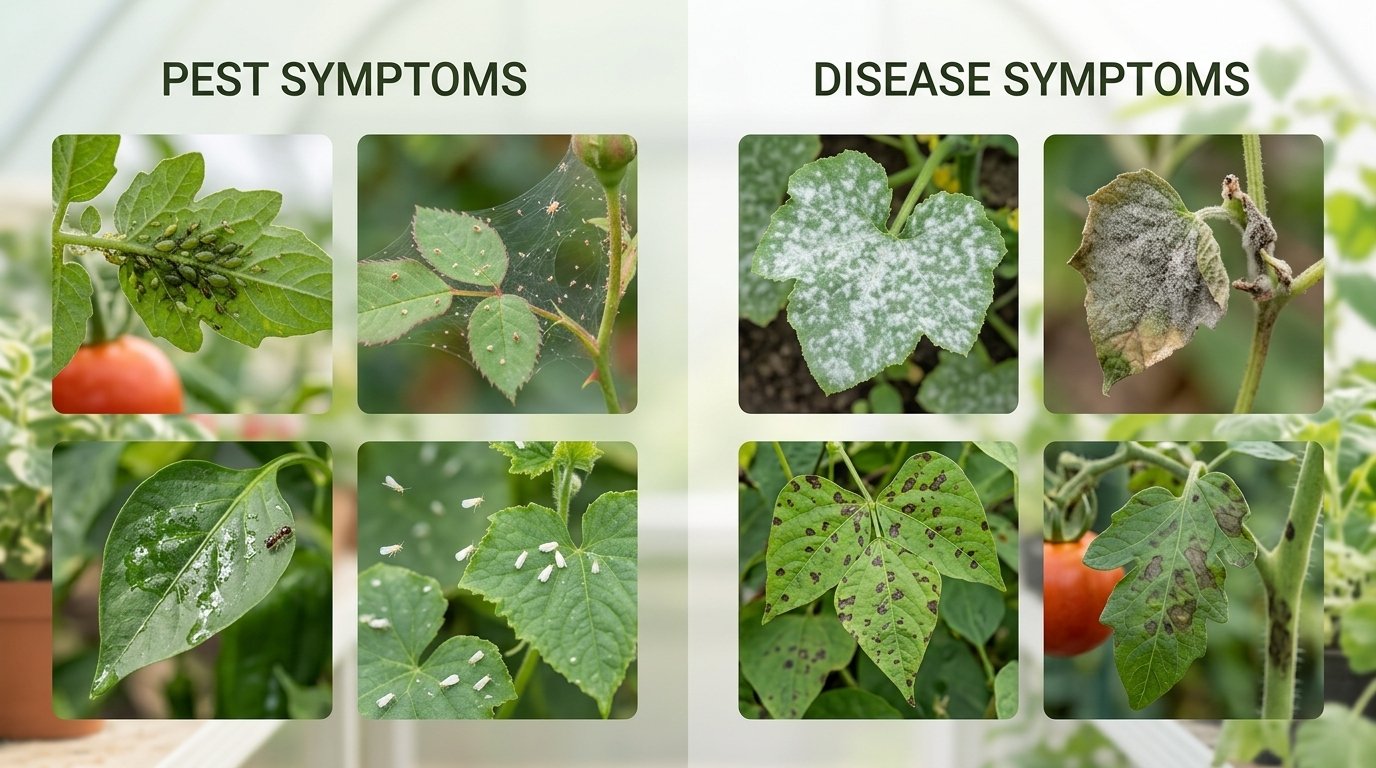
Before you can treat a problem, you need to know which category it falls into. The two have different causes and different fixes, and treating one like the other wastes time.
You're likely dealing with a pest if you see:
Small moving insects, especially on the undersides of leaves,
Fine webbing across leaves and stems,
Sticky residue on leaves (called honeydew) or a black, sooty coating growing on that residue,
Silvery or stippled patches on leaves with tiny black specks,
Ants traveling up and down your plants (ants "farm" aphids for the honeydew they produce, so an ant trail is often your first clue that aphids are nearby),
You're likely dealing with a disease if you see:
A white or gray powdery coating on leaf surfaces, with no insects visible,
Fuzzy gray or brown growth on leaves. stems, or fruit.
Water-soaked spots that spread and darken over a few days.
Wilting that doesn't improve after watering.
A black, sooty film on leaves with no sticky residue underneath (this is a secondary sign of a past insect problem, not an active infection)
If you're still not sure, or the problem is spreading fast and you're worried about your whole crop, your local Cooperative Extension office can identify a sample for you this is a free or low-cost service in most U.S. counties, and it's the most reliable way to get a definitive answer on anything you can't confidently identify yourself.
Why Greenhouse Conditions Make This More Likely
It helps to understand why this happens in a greenhouse more than it does outdoors, because that understanding is what makes prevention make sense.
Three things have to line up for a pest or disease outbreak to take hold: a plant that's vulnerable to it, the pest or pathogen actually being present, and an environment that lets it multiply. A greenhouse doesn't create pests or disease out of nothing, but it does a very good job of supplying that third condition. Warm, still, humid air is close to ideal for many common fungal diseases. Reduced airflow compared to the open garden means pests spread from plant to plant more easily, and there's no wind or rain to knock small populations back the way there often is outside. Your greenhouse also keeps out many of the natural predators birds, ground beetles, and other insects that would otherwise help keep pest numbers down outdoors.
None of this means a greenhouse is a bad idea. It means the environmental controls you already have ventilation, spacing, watering habits do double duty as pest and disease prevention, not just climate control.
Common Greenhouse Pests
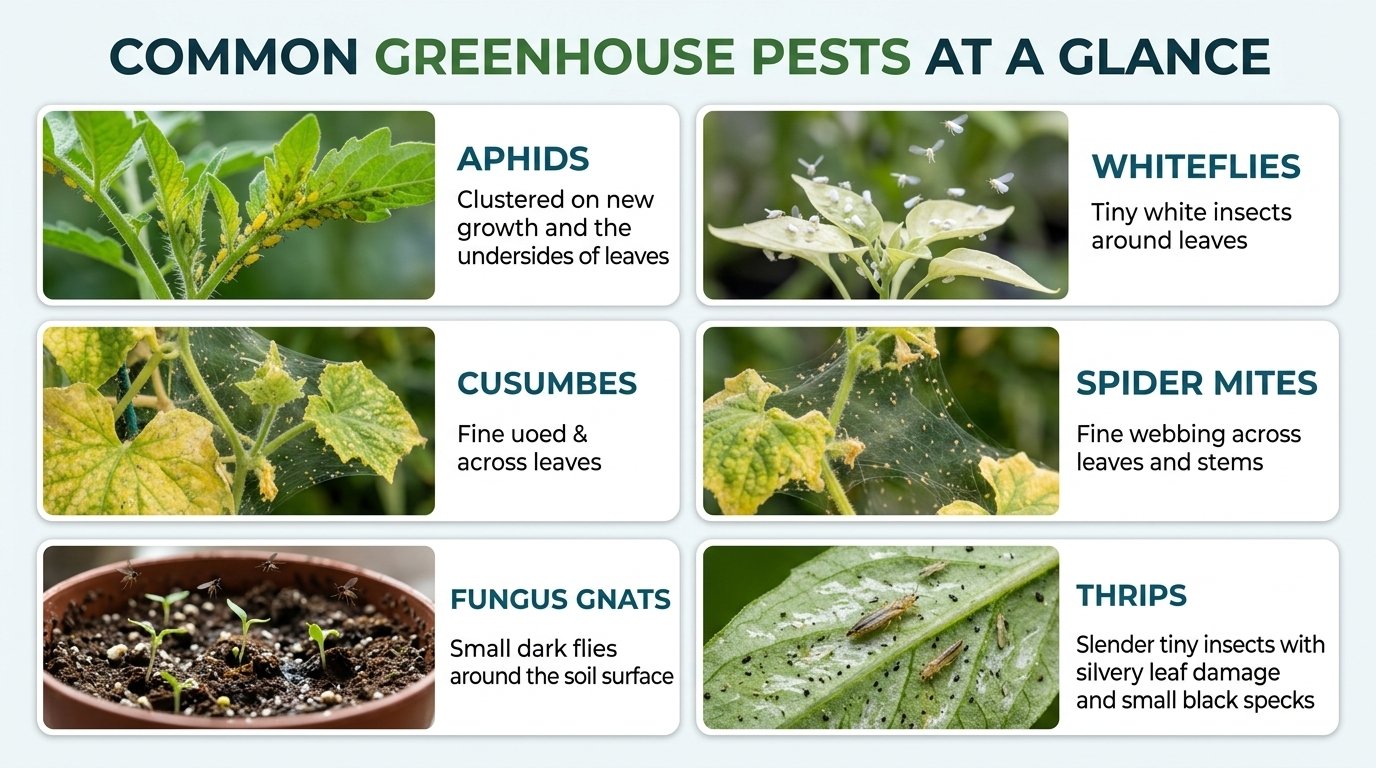
Here are the pests most home greenhouse growers run into, in roughly the order you're likely to encounter them.
Aphids
Aphids are small, soft-bodied insects, usually green, black, or pink, that cluster on new growth and the undersides of leaves. They feed by sucking sap from the plant, and because they reproduce without needing to mate, a small population can turn into a large one within a couple of weeks. The honeydew they excrete often attracts ants and can develop a black sooty mold on top of it.
For a light infestation, a strong, repeated spray of water daily or every other day for about a week is often enough to knock the population down and interrupt their life cycle. Insecticidal soap is a reasonable next step if water alone doesn't resolve it. Ladybugs and lacewings can help too, but they work best when released before a population has gotten out of control, not as a rescue after the fact.
Whiteflies
Whiteflies look like tiny white moths and will scatter into the air when you brush against an infested plant. Like aphids, they feed on sap and produce honeydew, and heavy infestations can stunt growth and damage leaves and fruit.
Prevention matters more with whiteflies than with almost any other greenhouse pest, because an established population is genuinely difficult to bring back under control. Insect screening on vents and doors is the single most effective long-term defense. Yellow sticky traps are useful both for monitoring how many whiteflies are present and for catching some of the adult population in a small greenhouse. If you already have an infestation, a strong water spray followed by insecticidal soap is a reasonable starting point, and several species of parasitic wasp are available as a biological control if the problem persists.
Spider Mites
Spider mites are barely visible to the naked eye you're more likely to notice the fine webbing they leave across leaves and stems before you spot the mites themselves. They're especially fond of hot, dry conditions, which makes them more common near heat sources or during summer heat waves than during cooler, more humid stretches.
A thorough water spray, top to bottom, will physically remove much of the webbing and many of the mites. Because they favor dry conditions, simply increasing humidity slightly can slow them down. Predatory mites are an effective biological control if the infestation is more than a light one.
Fungus Gnats
Fungus gnats are small, dark, long-legged flies you'll usually notice hovering near the soil surface rather than on the leaves themselves. The adults are mostly a nuisance, but the larvae live in wet growing media and can damage young roots, and they're capable of spreading soil-borne diseases like Pythium root rot.
Fungus gnats are attracted to consistently damp soil, so the most effective fix is usually adjusting your watering habits rather than reaching for a spray let the top inch or so of soil dry out between waterings.
Removing algae and spilled potting mix from benches and floors also helps, since gnats will breed in those damp surfaces too. Beneficial nematodes applied to the soil are an effective biological option if adjusting watering doesn't fully resolve the problem.
Thrips
Thrips are very small, slender insects that are easiest to identify by their damage rather than the insect itself: silvery, stippled patches on leaves with tiny black specks of frass (thrips droppings), along with distorted new growth or deformed flowers.
An established thrips population is one of the harder greenhouse pests to control, which makes prevention especially important here. Insect screening rated specifically for thrips (a finer mesh than standard screening) on vents and intakes is the most reliable long-term defense. Blue or yellow sticky traps help with monitoring. If thrips are already present, predatory mites and certain beneficial nematodes can help, though they typically need to be applied more than once to have a lasting effect.
Common Greenhouse Diseases
Diseases tend to be less visually dramatic than pests at first, which is part of why they're often caught later. Here are the two you're most likely to encounter.
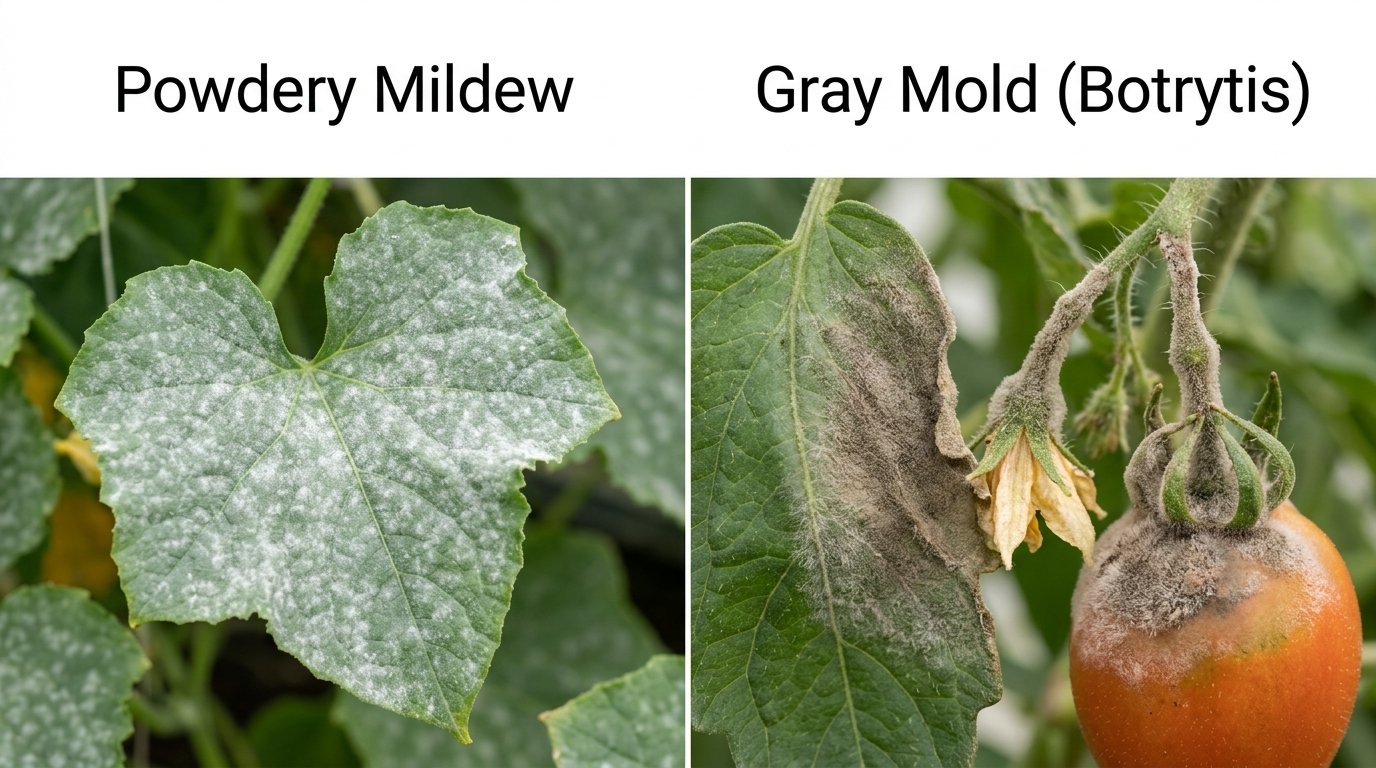
Powdery Mildew
Powdery mildew shows up as a white or light gray, dusty-looking coating on leaf surfaces, usually starting on the upper side of older or lower leaves before spreading. Unlike many fungal diseases, it doesn't need wet leaves to get started it spreads well even in relatively dry conditions, as long as humidity is moderate to high and airflow is limited. That's part of why it's one of the most common greenhouse disease complaints: greenhouses are frequently short on airflow even when they aren't especially wet.
Improving air circulation is the single most effective thing you can do, both to prevent powdery mildew and to slow it down once it appears. Circulation fans, wider plant spacing, and pruning out excess lower growth in a dense canopy all help. If it's already established, a baking-soda-based or potassium bicarbonate spray can slow its spread when applied early and consistently, and several biofungicide products are available for more persistent cases.
Gray Mold (Botrytis)
Gray mold, caused by the fungus Botrytis, appears as soft, fuzzy gray-to-brown growth on leaves, stems, flowers, or fruit. Unlike powdery mildew, it favors cooler temperatures combined with high humidity and actual leaf wetness, which is why it's more common in the cooler, damper stretches of the growing year than in the height of summer.
The most effective response is a combination of improved airflow, reduced humidity (particularly overnight, when temperatures drop and condensation is more likely), and prompt removal of affected plant material, since gray mold spreads readily from dead or dying tissue. Once it's established on fruit or flowers, affected parts usually need to be removed rather than treated in place.
Building a Simple Prevention Routine (IPM, Made Practical)
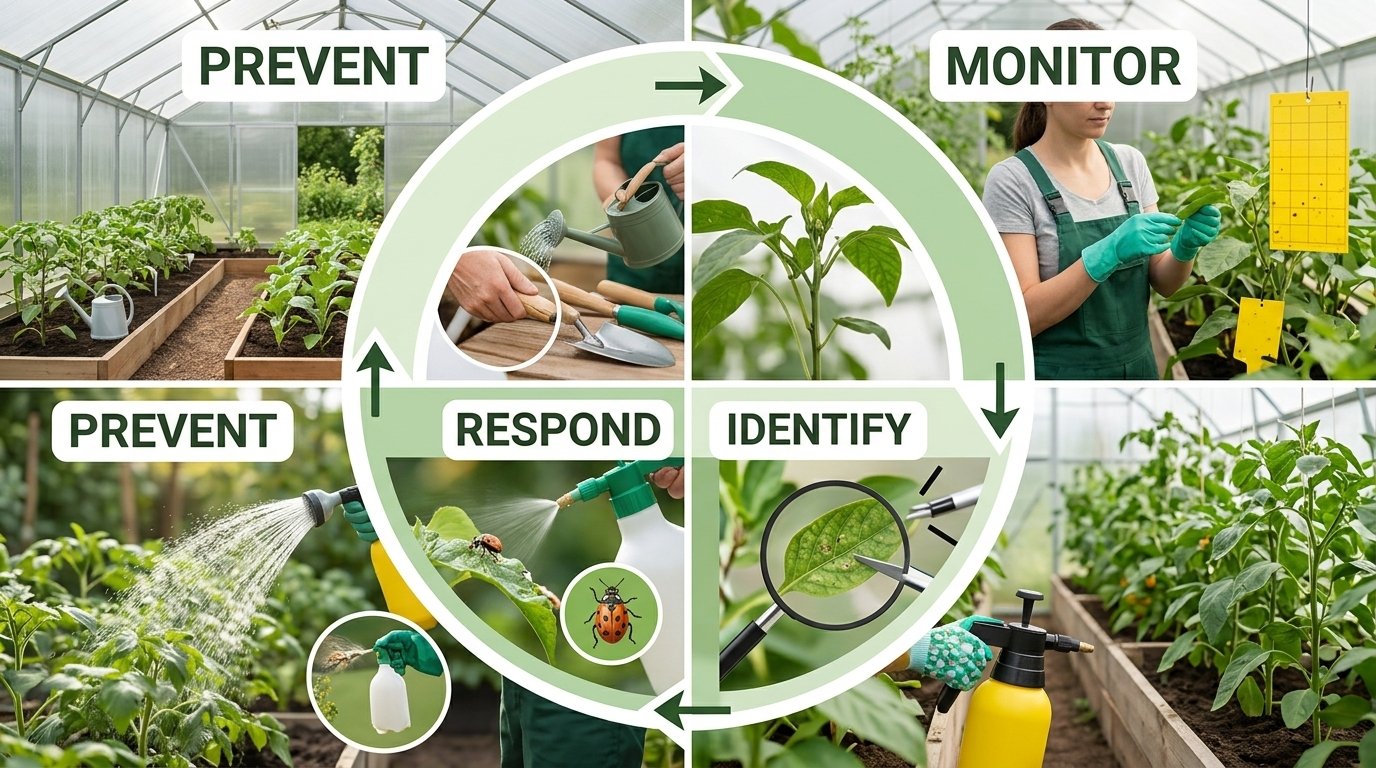
Integrated Pest Management, or IPM, sounds like a commercial-farming term, and in its full form, it is one. But the underlying idea is simple enough for any home greenhouse: instead of only reacting to problems as they appear, you build a routine of prevention, regular checking, and a proportionate response when something does show up. It comes down to four habits.
Prevent. Most prevention is really just good greenhouse management: don't overwater, don't overfertilize, keep the greenhouse free of dead plant material and weeds, and inspect any new plant before it goes anywhere near your existing ones. Overfertilizing, especially with nitrogen, is worth calling out specifically it produces soft, lush growth that's more attractive to aphids, whiteflies, mealybugs, and spider mites, so more fertilizer is not automatically better for plant health or pest resistance. Overwatering and high soluble salt levels in the soil similarly encourage root rot diseases like Pythium.
Monitor. Get in the habit of checking your plants roughly twice a week, and make a point of looking at the undersides of leaves, not just the tops — many pests and early disease symptoms start there and go unnoticed for weeks otherwise. A few yellow sticky cards placed near vents, doors, and among your plants will catch flying pests like whiteflies, fungus gnats, and thrips before you'd otherwise notice them, giving you an early warning rather than a surprise.
Identify. Use the descriptions above, or your local Cooperative Extension office, to correctly name what you're seeing before you treat it. Treating a disease like a pest, or vice versa, wastes time and can let the real problem get worse while you're addressing the wrong thing.
Respond, proportionately. This is where a lot of well-meaning gardeners overcorrect. The instinct when you spot a problem is to reach for the strongest treatment available, but that's rarely the right first move. Start with the least invasive option that's likely to work, and escalate only if it doesn't.
Choosing the Right Level of Response
Not every pest or disease problem calls for the same tool. It helps to think of your options in three tiers, and to start at the top.
A light aphid population, for example, often resolves with nothing more than a change in watering and a few days of water spraying no product purchase required. A well-established whitefly infestation, on the other hand, may need insect screening (cultural), parasitic wasps (biological), and insecticidal soap (chemical) working together. The point isn't to avoid chemical controls entirely; it's to reach for them because they're the right tool for the situation, not because they're the first thing that comes to mind.
If you're treating anything you plan to eat, always check the product label for guidance on how close to harvest it's safe to apply, and follow it exactly this varies by product and isn't something to guess at.
Sanitation and Prevention Habits Worth Keeping
A handful of ongoing habits do more for long-term pest and disease pressure than any single treatment.
Keep the greenhouse itself clean. Spilled potting soil, dead leaves, and algae buildup on benches and floors all give pests and diseases somewhere to take hold, even when your actual plants look fine. A quick sweep and clear-out every couple of weeks goes a long way.
Quarantine new plants. Before adding a new plant to an established greenhouse, take a few minutes to inspect it closely both sides of the leaves, the stems, and the soil surface and consider keeping it separate from your other plants for a week or two if anything looks uncertain. Most serious outbreaks in an otherwise clean greenhouse start with a single infected or infested plant brought in from outside.
Space plants for airflow. Crowded plants create the still, humid microclimate that both pests and fungal diseases favor. Give plants the spacing their tag or seed packet recommends, even when it's tempting to fit in a few more.
Clean up between growing seasons. At the end of a growing cycle, remove old plant debris, wash down benches and any reused pots, and give the space a chance to dry out before the next round of planting.
Checklist Weekly Scouting Routine
Check the undersides of leaves on a handful of plants, not just the tops
Look near vents, doors, and the base of plants common entry points and hiding spots
Check yellow sticky cards if you have them, and note what's on them
Look for ants, which often signal aphids nearby
Check the soil surface near the stem for any sign of fungus gnat activity
Note anything unusual so you can track whether it's getting better, worse, or staying the same
Checklist Before You Bring In a New Plant
Inspect both sides of every leaf
Check the stem and any growth points closely
Check the soil surface for insects or larvae
If anything looks questionable, keep the plant separate from the rest of your greenhouse for one to two weeks before moving it in
Common Mistakes to Avoid
Treating a single sighting as an emergency. A few aphids or one leaf with early powdery mildew is not a crisis. Reaching immediately for the strongest available spray skips past the simpler, cheaper options that often work just as well.
Overfertilizing to "help" a stressed plant. As covered above, extra fertilizer especially nitrogen tends to make plants more attractive to several common pests, not less susceptible.
Only checking the tops of leaves. Most of the pests and early disease symptoms covered in this guide start on the undersides of leaves or near the soil. A quick glance at the top of the canopy will miss most early problems.
Skipping quarantine for new plants because they "look fine." Many pest and disease problems aren't visible in their earliest stages. A week or two of separation costs little and prevents a lot.
Assuming any mold or mildew means you've failed as a grower. Mold and mildew spores are present in essentially every growing environment, including the healthiest ones. Seeing some doesn't mean something has gone wrong it means it's worth checking your airflow and humidity.
Frequently Asked Questions
What are the most common greenhouse pests?
The pests home greenhouse growers run into most often are aphids, whiteflies, spider mites, fungus gnats, and thrips. Aphids and fungus gnats tend to show up first for most new growers, since both are drawn to the warm, humid conditions and consistently moist soil common in a new greenhouse setup.
Is it a pest or a disease?
Moving insects, webbing, and sticky residue point to a pest. Powdery coatings, fuzzy growth, and spreading spots with no visible insects point to a disease. If you're not sure after checking both lists above, your local Cooperative Extension office can identify a sample for you.
How do I get rid of aphids in my greenhouse?
Start with a strong, repeated spray of water for several days to physically remove them and interrupt their life cycle. If that doesn't fully resolve it, insecticidal soap is a reasonable next step. Ladybugs and lacewings work well as a preventative measure but are less effective once a population is already large.
What causes powdery mildew in a greenhouse, and how do I stop it?
Powdery mildew is favored by limited airflow and moderate-to-high humidity, and unlike many fungal diseases, it doesn't require wet leaves to spread. Improving air circulation through fans, wider spacing, and pruning dense growth is the most effective prevention and the first response if it appears.
Are beneficial insects safe to use in a home greenhouse?
Yes, beneficial insects like ladybugs, lacewings, and predatory mites are a well-established, safe pest control method and are widely used by home and commercial growers alike. They work best when introduced early, before a pest population has grown large, rather than as a last resort.
Can I use insecticidal soap or neem oil on food crops?
Both are commonly used on edible crops, but always check the specific product label for any waiting period between application and harvest, and follow it exactly. This detail varies by product and shouldn't be assumed.
Why does my greenhouse keep getting mold or mildew?
Mold and mildew spores are present in virtually every growing environment, and a greenhouse's warmth and humidity give them favorable conditions to take hold. Recurring problems usually point to an airflow or humidity issue rather than anything you're doing wrong with the plants themselves improving ventilation is usually the most effective fix.
Do I need to remove an entire infested plant, or can I save it?
It depends on how far the problem has spread. A light, localized infestation on part of a plant can often be managed by removing just the affected leaves or fruit and treating the rest. A heavily infested plant, especially one showing stunted growth or spreading disease, is usually better removed entirely to protect the rest of your greenhouse.
The Bottom Line on Greenhouse Pest & Disease Control
Greenhouse pest and disease control isn't about achieving a perfectly sterile growing space that's neither realistic nor necessary. It's about recognizing problems early, correctly identifying what you're dealing with, and responding in proportion to the actual situation rather than the worst-case scenario in your head.
Start by learning to tell a pest problem from a disease problem, build a simple twice-weekly habit of checking your plants (undersides of leaves included), and keep the cultural basics in place: don't overwater, don't overfertilize, and quarantine new plants before they join the rest of your greenhouse. Most problems, caught early, resolve with the simplest tools available. The greenhouse growers who deal with pests and disease the least aren't the ones with the strongest sprays they're the ones who check their plants regularly and catch small problems while they're still small.
Pest and disease prevention works best as part of a bigger routine our guide to greenhouse gardening tips ties it together with watering, soil, and temperature management.