
Greenhouse pollination is one of the most misunderstood parts of growing under glass.
If your greenhouse tomatoes, peppers, cucumbers, or squash are covered in flowers but you're not seeing fruit or the fruit you do get is small, lopsided, or sparse you haven't done anything wrong. This is one of the most common surprises for anyone moving from outdoor gardening into a greenhouse, and it almost always comes down to one thing: pollination, which happens automatically outdoors, often doesn't happen automatically indoors.
This guide explains why that is, how to tell which of your plants actually need help, and exactly how to hand-pollinate the crops most home greenhouse growers plant tomatoes, peppers, cucumbers, and squash. It also walks through your other real options, attracting pollinators naturally or bringing in commercial bees, so you can decide what actually makes sense for your greenhouse rather than defaulting to whatever a particular seller happens to recommend.
Why Flowers Don't Always Mean Fruit
Understanding greenhouse pollination starts with one key fact: a flowering plant and a fruiting plant are not the same thing. Flowering means the plant is healthy and ready to reproduce. Fruiting only happens after pollination the transfer of pollen from the male part of a flower to the female part has actually occurred. A plant can flower beautifully for weeks and still produce little or no fruit if that transfer isn't happening.
Outdoors, this transfer mostly takes care of itself. Wind moves pollen between flowers, and bees, flies, and other insects move it as they forage. A greenhouse interrupts both of those mechanisms. The structure blocks the wind that would otherwise shake pollen loose and carry it between plants, and the walls and roof limit how many insects can get in and out. Add screened vents, which most greenhouse owners use to keep pests out, and insect access drops even further.
None of this means your greenhouse was a bad idea. It means the job that wind and wild insects used to do for free now needs a deliberate substitute, whether that's your own hands, a few plants chosen to attract pollinators, or bees brought in on purpose.
Quick Answer: Most greenhouse crops benefit from pollination help, because the structure blocks the wind and limits the insect access plants rely on outdoors. Tomatoes and peppers usually just need a gentle shake; cucumbers and squash typically need pollen manually transferred between separate male and female flowers.
Which Plants Actually Need Help
Not every crop needs the same amount of greenhouse pollination assistance, and understanding why comes down to a bit of basic flower anatomy.
Some flowers are "complete," meaning a single flower contains both the male part (the anther, which produces pollen) and the female part (the stigma, which receives it). Tomatoes and peppers have complete flowers. Because the male and female parts are right next to each other, these flowers often self-pollinate with nothing more than a light disturbance wind outdoors, or a gentle shake indoors.
Other plants have "incomplete" flowers, meaning male and female flowers are separate from each other, sometimes even on different parts of the same plant. Squash, zucchini, and most cucumbers work this way. Because the pollen has to travel from one flower to a completely different flower, these crops depend much more heavily on an outside carrier an insect outdoors, or your hand indoors to make pollination happen at all.
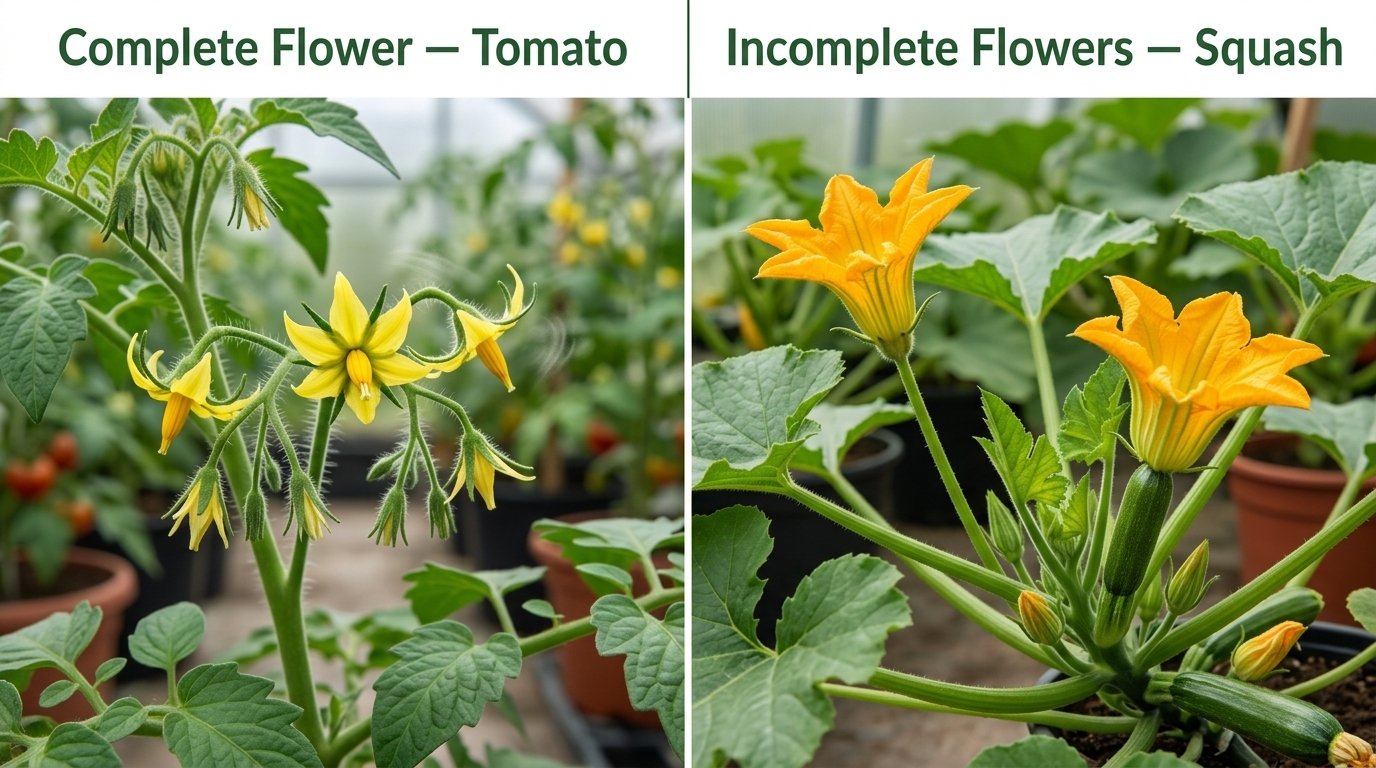
This distinction is the single most useful thing to understand before you start troubleshooting, because it tells you immediately whether your problem is likely to be solved with a two-second shake or a more deliberate hand-pollination routine.
How to Hand-Pollinate Your Greenhouse Crops
Hand pollination sounds more delicate than it actually is. For most home greenhouse crops, it takes seconds per flower and no special equipment.
Tomatoes and peppers (complete flowers). Because these flowers already contain both male and female parts, all they usually need is a way to release the pollen. Gently tap or shake the flower cluster with your finger, or use a small battery-operated toothbrush or an electric pollinator tool held just behind the flower to create a brief vibration. Midday, when humidity is often a bit lower, tends to work well for this pollen generally releases more easily when it isn't damp. Doing this every day or two while the plant is actively flowering is enough to noticeably improve fruit set.
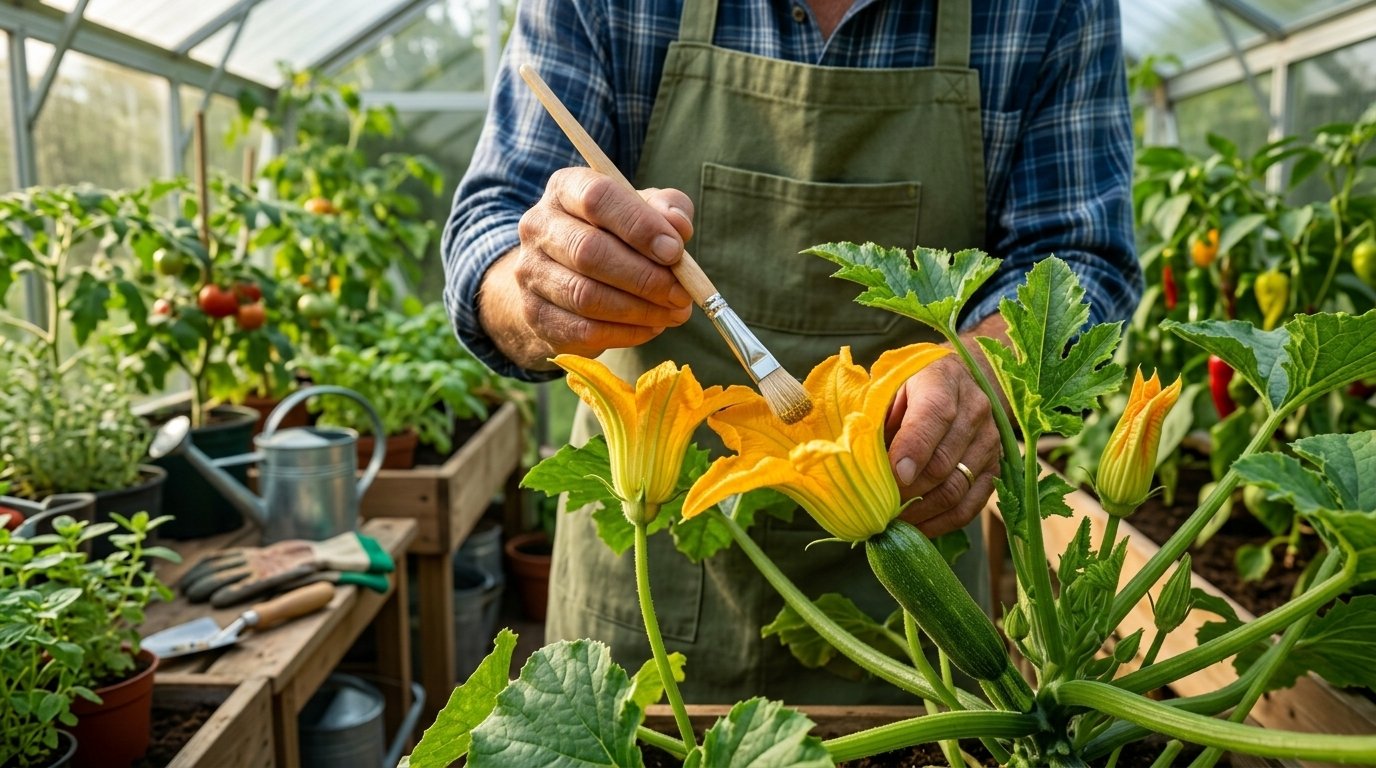
Cucumbers, squash, and zucchini (incomplete flowers). These need pollen physically moved from a male flower to a female one. Male flowers grow on a plain stem; female flowers have a small, immature fruit visible at the base, just behind the petals. Using a small, soft paintbrush, cotton swab, or even a clean feather, gently collect pollen from the center of an open male flower and dab it onto the center of an open female flower. Do this in the morning, when flowers are freshly open, and repeat every day or two throughout the flowering period, since individual flowers are often only receptive for a single day.
Checklist Hand Pollination Routine
Pollinate midday for complete flowers (tomatoes, peppers); morning for incomplete flowers (cucumbers, squash).
Repeat every one to two days while plants are actively flowering.
For complete flowers: a gentle shake or brief vibration is enough.
For incomplete flowers: transfer pollen from an open male flower to an open female flower with a small brush or swab.
Avoid pollinating the same flower repeatedly once you've done it excessive handling. can damage delicate flower parts and reduce fruit set rather than improve it.
Temperature and Humidity Matter More Than You'd Think
Even with perfect technique, pollination can fail if the environment inside your greenhouse isn't right. Pollen itself is sensitive to heat and moisture, and outside a fairly specific range, plants stop producing viable pollen or the pollen that is produced fails to transfer properly.
For tomatoes, according to UConn Extension, nighttime temperatures between about 55–70°F support healthy pollen production, and daytime temperatures above roughly 85°F can start to interfere with it, with relative humidity between 50–80% supporting proper pollen release. Peppers follow a similar pattern, generally needing nighttime temperatures in a comparable range and tolerating daytime temperatures a little higher, up to around 90°F, before pollination quality drops off, with relative humidity in the same 50–80% range. Air that's too dry causes pollen to become brittle and disperse poorly, while air that's too humid makes it clump together and stick.
If your fruit set has been consistently poor despite good hand-pollination technique, it's worth checking these two factors before assuming something else is wrong. A thermometer and a basic hygrometer are inexpensive and take the guesswork out of this if you're regularly seeing daytime temperatures well above these ranges, improving ventilation and shading is likely to help your pollination results more than any technique change will.
Common Mistake: Assuming heavy flowering means pollination is already succeeding. Flowering and fruiting are two separate steps, and a plant can flower abundantly while setting very little fruit if pollen isn't actually being transferred.
Should You Attract Pollinators or Bring In Bees?
Hand pollination works well for most home greenhouse pollination setups, but it isn't your only option. and for a larger setup or a busier schedule, it may not be the best fit. Here's an honest look at all three approaches, without assuming one is automatically right for you.
Hand pollination costs nothing and gives you full control, which makes it the right starting point for nearly every home greenhouse. The only real downside is that it takes a small amount of consistent attention.
Attracting natural pollinators by keeping vents open when weather allows, planting a few flowering herbs like borage or lavender near the greenhouse entrance, or simply leaving a door open during the day can genuinely help, especially in a greenhouse that isn't fully sealed off. It shouldn't be relied on as your only method in a tightly enclosed structure, since you have little control over how many pollinators actually find their way in.
Commercial bumblebee hives are worth considering if you have a larger greenhouse with many flowering plants over a long season, since a colony can handle far more flowers than hand pollination realistically allows. According to SARE (Sustainable Agriculture Research and Education), a bumblebee colony typically contains no more than around 300 bees — far smaller than a honeybee colony, which can hold up to 30,000 which actually makes bumblebees easier to manage in an enclosed space. Colony lifespan varies somewhat by supplier and hive type, but Michigan State University Extension notes that commercial bumblebee colonies used for greenhouse pollination are generally short-lived, typically remaining productive for roughly 8 to 12 weeks before needing to be replaced. For most home greenhouses with only a handful of plants, this is more infrastructure and cost than the situation calls for, but it's a legitimate option once you're managing a genuinely larger space.
Checklist Before You Buy a Commercial Pollinator
How many flowering plants do you actually have right now?
How large is your greenhouse, and how long is your typical growing season?
Can you realistically commit five minutes every day or two to hand-pollinating instead?
Have you priced the ongoing cost of hive replacement, not just the first purchase?
If you answer these honestly and hand pollination still feels manageable, it's the more cost-effective place to start. You can always add commercial pollinators later if your greenhouse grows.
A Note on Honeybees
It's worth calling out specifically: a honeybee hive is generally not a good fit inside a greenhouse, even though honeybees are the pollinator most people think of first. Honeybee foragers rely heavily on communicating the location of the best available flowers to the rest of the colony, so if better forage exists outside and vents are open, they tend to focus their efforts there instead of the flowers inside.
Beekeepers and researchers have also documented honeybees struggling to navigate clear glass and plastic greenhouse surfaces, sometimes becoming trapped near the roofline rather than finding their way back to flowers or the hive, and studies of honeybee colonies confined in greenhouses have found signs of physiological stress over time. Bumblebees tolerate enclosed conditions considerably better and are, by a wide margin, the standard choice for commercial greenhouse pollination; mason and leafcutter bees are a newer, more niche alternative that some growers have had success with, but they are not yet a mainstream substitute in the way bumblebees are.
Did You Know: Bumblebees "buzz pollinate" by gripping a flower and vibrating their flight muscles against it, a motion that shakes loose pollen a gentle touch alone often can't release. This is part of why they're especially effective on tomatoes.
A Quick Way to Diagnose Your Fruit Problem
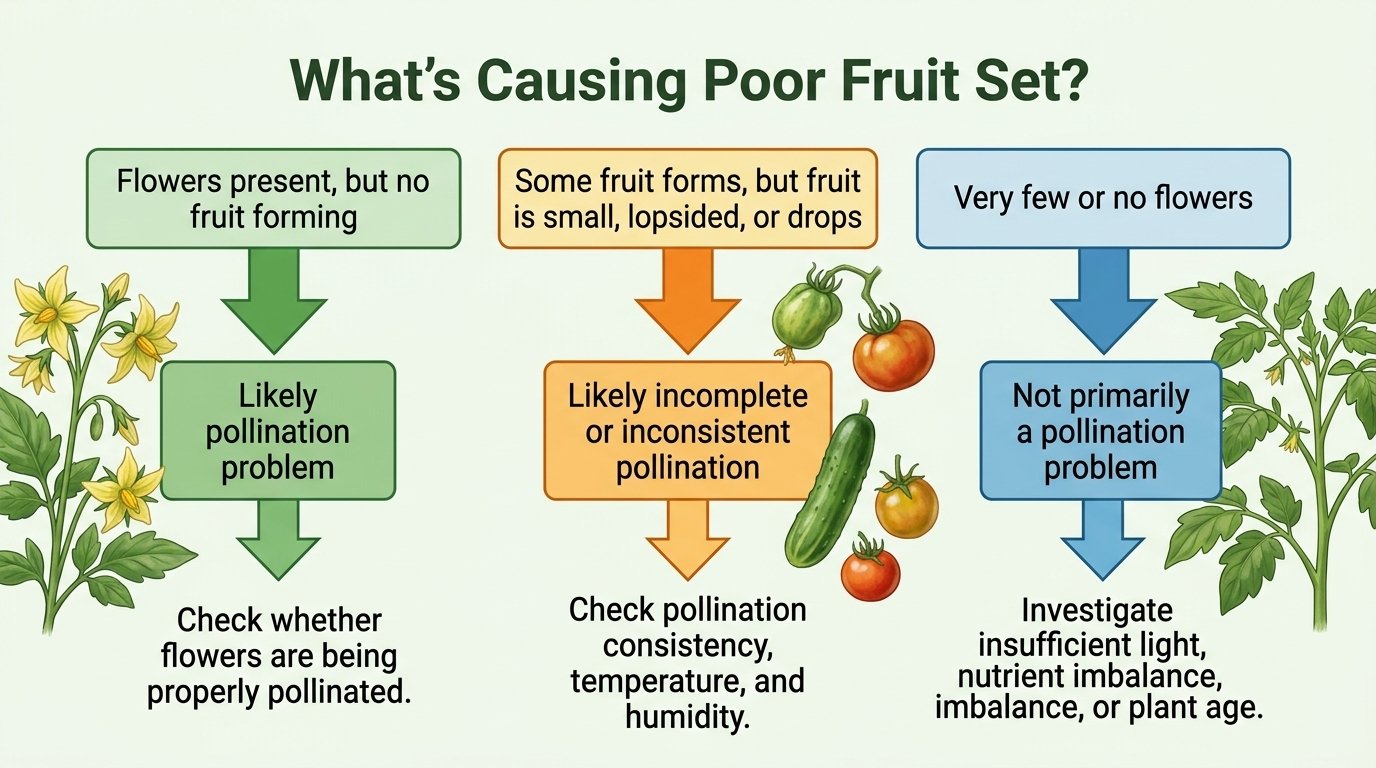
If you're not sure whether pollination is actually your issue, this quick check can help narrow it down:
Flowers present, but no fruit forming at all → Most likely a pollination problem. Start with the hand-pollination technique for your specific crop.
Some fruit forming, but it's small, lopsided, or drops before maturing → Likely partial or incomplete pollination. Check your temperature and humidity ranges, and make sure you're pollinating consistently rather than occasionally.
Very few or no flowers at all → Not a pollination issue. This points to something upstream insufficient light, a nutrient imbalance, or the plant still being too young and is worth investigating separately before worrying about pollination technique.
Frequently Asked Questions
Why aren't my greenhouse tomatoes producing fruit even though they're flowering?
This is almost always a pollination issue. Tomato flowers are self-pollinating, but they still need something to physically release the pollen normally wind or insect activity outdoors. Inside a greenhouse, that trigger is usually missing, so the flowers can bloom and then simply drop without ever setting fruit. A gentle shake or brief vibration of the flower cluster every day or two typically resolves it.
Do greenhouse plants need to be pollinated by hand?
It depends on the crop. Tomatoes and peppers have complete flowers and often just need a gentle shake to release pollen. Cucumbers and squash have separate male and female flowers and generally need pollen physically transferred between them, which makes hand pollination more important for these crops specifically.
How do I hand-pollinate tomatoes in a greenhouse?
Gently tap or shake the flower cluster, or hold a small vibrating tool (an electric pollinator or a battery-operated toothbrush works well) just behind the flower for a second or two. Do this around midday, when humidity is a bit lower, every day or two while the plant is actively flowering.
Can I put a beehive in my greenhouse?
A honeybee hive generally isn't recommended inside a greenhouse. Honeybees tend to struggle navigating clear glass and plastic surfaces and often focus their foraging outside if better resources are available there and vents are open, which makes them unreliable pollinators in an enclosed space. Bumblebee colonies are much better suited to greenhouse conditions and are the standard choice when commercial pollination assistance is used.
Do bumblebees work better than honeybees for greenhouse pollination?
Yes, generally. Bumblebees tolerate enclosed conditions better than honeybees and use a vibration technique called buzz pollination that's especially effective on crops like tomatoes. According to SARE, bumblebee colonies are also much smaller than honeybee colonies typically no more than about 300 bees compared to as many as 30,000 which makes them a more practical scale for most greenhouse setups.
How often should I hand-pollinate my greenhouse plants?
Every one to two days while plants are actively flowering is generally enough. Individual flowers, especially on cucumbers and squash, are often only receptive for a single day, so consistency matters more than doing it perfectly every single time.
Will screening my greenhouse vents block pollinators?
It can reduce natural insect access somewhat, which is one more reason hand pollination or a deliberate pollinator strategy is worth setting up rather than relying on insects finding their way in through a screen. If pest pressure requires screening, hand pollination becomes the more dependable primary method for crops that need it.
What does buzz pollination mean?
It's the technique bumblebees use to release pollen by vibrating their flight muscles against a flower, a motion that dislodges pollen more effectively than a light touch alone. It's part of why bumblebees are considered especially good pollinators for tomatoes and other nightshade crops.
The Bottom Line on Greenhouse Pollination
Greenhouse pollination isn't complicated once you understand why it's an issue in the first place: the wind and open insect access your plants relied on outdoors are largely missing indoors, so something else has to do that job. For most home greenhouses, that something is your own hands a quick shake for tomatoes and peppers, a small brush for cucumbers and squash, repeated every day or two while plants are flowering.
Start there. If your greenhouse grows large enough that hand pollination becomes genuinely impractical, attracting natural pollinators or bringing in a bumblebee colony are both legitimate next steps, not requirements. Flowers without fruit are a normal, well-understood part of greenhouse growing, and in almost every case, the fix is a lot simpler than it feels the first time you notice the problem.
Once pollination is handled, the rest of your greenhouse routine temperature, watering, soil, and pest prevention is covered in our complete guide to greenhouse gardening tips.