
If you've ever come home from a weekend away to find your greenhouse plants wilted, or you're tired of standing there every morning with a watering can, you've already found the real problem: hand-watering doesn't scale. Greenhouse irrigation systems solve exactly that a greenhouse dries out faster than an outdoor garden, and the moment your schedule gets busy or unpredictable, watering is usually the first thing to slip.
The fix isn't complicated, but it does require knowing which system actually fits your situation. Greenhouse irrigation systems range from a simple soaker hose you can lay down in ten minutes to a fully automated drip setup that waters itself while you're at work. This guide walks through every major option, shows you exactly how to size and set up a basic drip system yourself, and covers the automation, water-saving, and troubleshooting details that most guides skip entirely.
Quick answer: For most home greenhouses, drip irrigation is the best all-around choice it delivers water directly to the roots, keeps foliage dry (which matters more than most people realize), and uses water efficiently. Soaker hoses are a simpler, cheaper alternative for smaller setups. Overhead sprinklers and misting systems have their place, especially for seedlings, but they raise humidity and foliage wetness in ways that can invite disease if you're not careful.
Why Your Greenhouse Needs a Dedicated Watering System
A greenhouse dries out faster than you'd expect, mostly because the enclosed structure traps heat and increases evaporation. That means the watering habits that worked fine in an outdoor garden often fall short here plants can go from fine to stressed within a single hot afternoon if nobody's around to notice.
There's also a connection that's easy to overlook: how you water affects how humid your greenhouse gets, and humidity directly affects disease risk. Overhead watering methods wet the leaves and the air along with the soil, and that extra moisture is exactly what fungal problems like powdery mildew need to get started. Watering methods that deliver water straight to the root zone drip irrigation and soaker hoses avoid this problem almost entirely, simply because they never wet the foliage in the first place.
(For a full breakdown of how airflow and humidity affect disease risk in a greenhouse, our guide to greenhouse ventilation covers the mechanics in depth.)
Comparing the Main Types of Greenhouse Irrigation Systems
Here's an honest look at the main greenhouse irrigation systems, what each one is actually good at, and where each one falls short.
Greenhouse Irrigation System Comparison
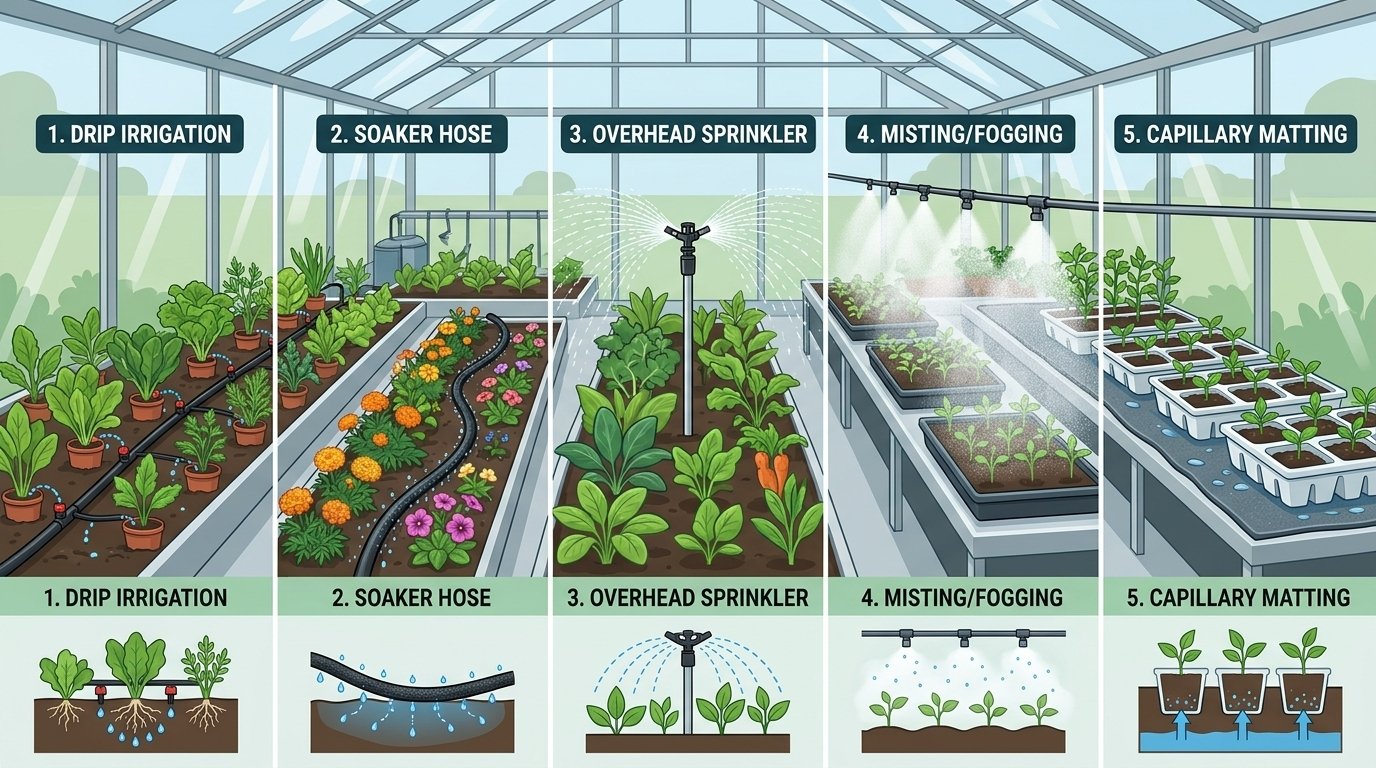
Drip Irrigation
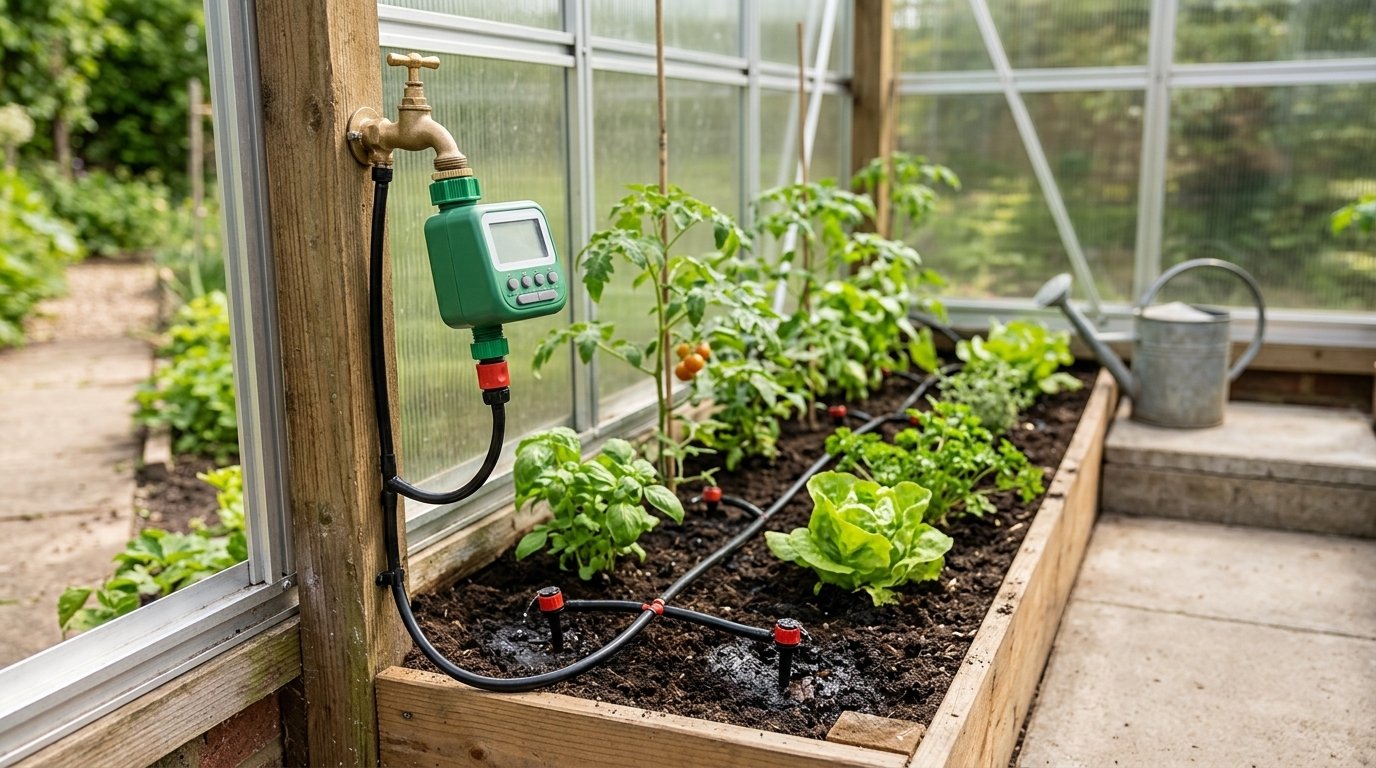
Drip irrigation uses a network of tubing with small emitters spaced along it, each one releasing water slowly right at the base of a plant. Because the water goes straight to the roots instead of spraying through the air, very little is lost to evaporation, and the foliage stays dry.
This is generally the best default choice for a home greenhouse. It works for containers, raised beds, and in-ground rows alike, and it's flexible enough to expand as your greenhouse setup grows.
Soaker Hoses
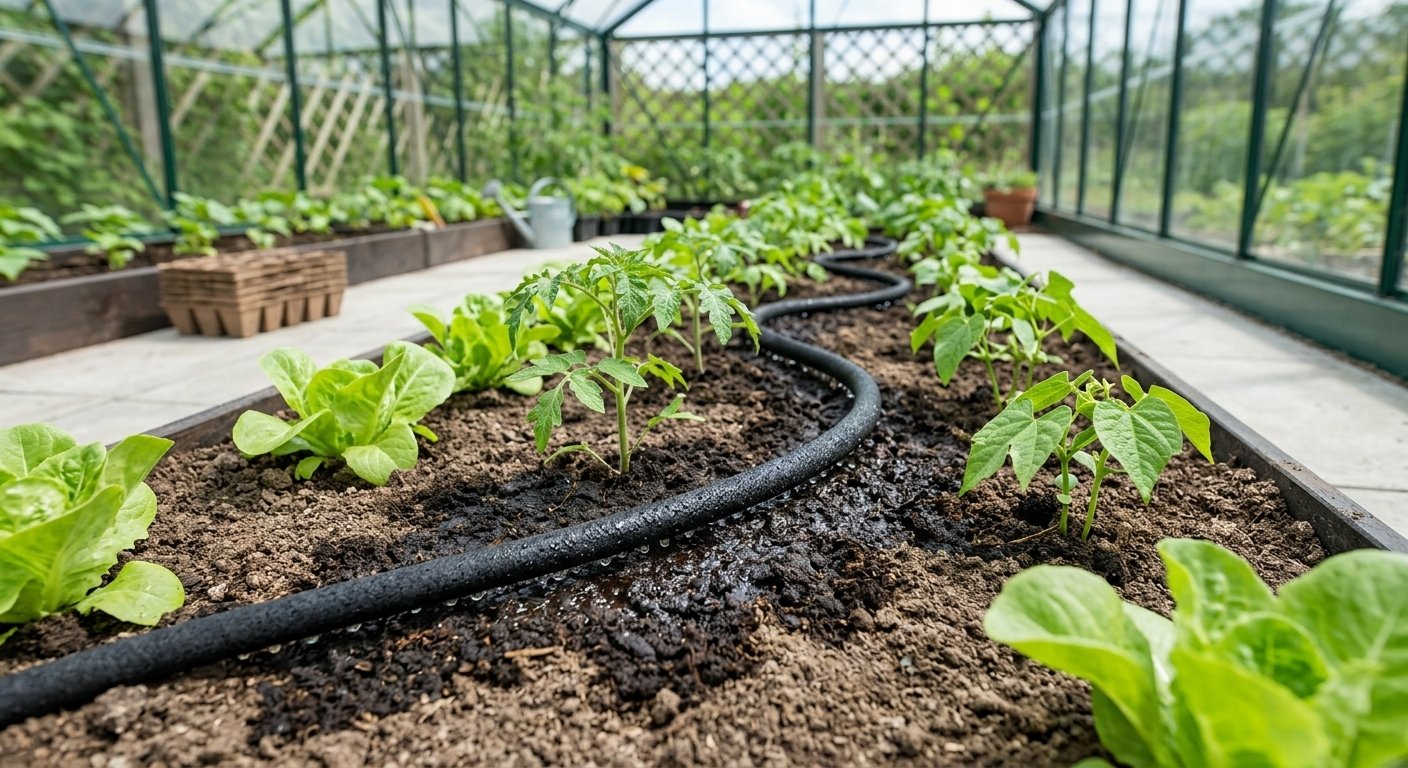
A soaker hose is exactly what it sounds like: a hose made of a porous material that weeps water slowly along its entire length when connected to a spigot. Lay it along a row or bed, and it waters everything beneath it evenly.
Soaker hoses are the simplest, cheapest way to get root-level watering without assembling individual emitters and tubing. The trade-off is less precision you can't easily adjust how much water an individual plant gets but for a straightforward raised bed of similar plants, that's rarely a problem.
Overhead Sprinklers
Overhead sprinklers spray water down over a wide area, which makes them fast for covering a large bed all at once. The downside is exactly what you'd expect from spraying water through the air inside an enclosed space: it wets the foliage and raises humidity, both of which increase disease risk for plants that are already prone to fungal problems.
Common Mistake: Choosing overhead watering for disease-prone plants like tomatoes without accounting for the added humidity and wet-foliage risk. If you do use overhead watering, water in the morning so leaves have time to dry before evening.
Misting and Fogging Systems
Misting and fogging systems release extremely fine water droplets into the air. They're not really designed to water mature plants at the root their real strength is propagation. Seedlings and cuttings often need the higher humidity and gentle moisture these systems provide, especially before they've developed a strong root system.
Capillary Matting
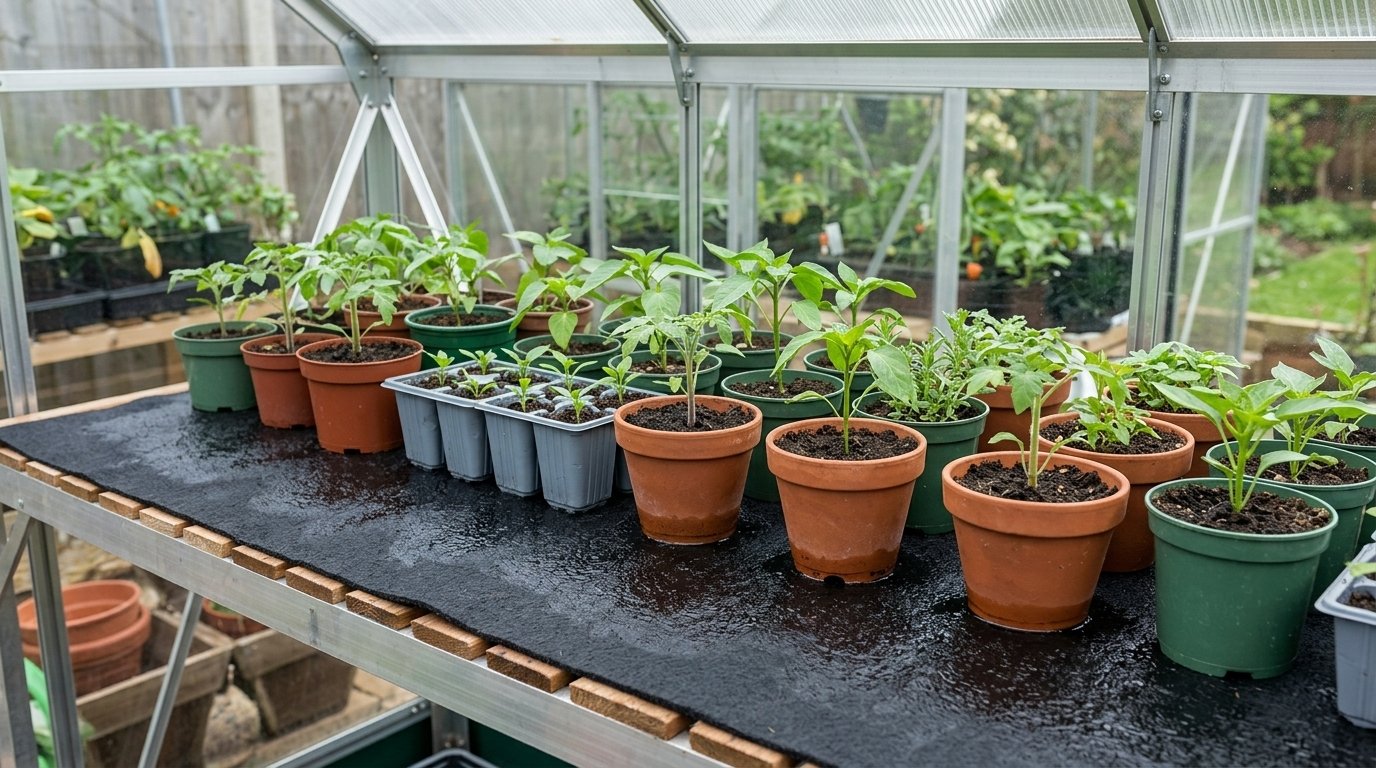
Capillary matting is an absorbent fabric mat placed under trays or pots. The mat stays moist, and plants draw up water through the drainage holes in their containers as needed. It's a low-effort, low-cost way to keep seed trays and container plants evenly moist without daily attention, though it's really only practical for smaller container setups rather than in-ground beds.
How Often Should You Actually Water?
This is where a lot of guides get vague, so here's something more concrete. According to Texas A&M AgriLife Extension research on greenhouse vegetable production, automated drip irrigation systems typically run on a cycle of about once every four days on average, though this can range from as often as daily to as infrequently as once a week depending on weather and plant needs. A single watering session usually lasts one to three and a half hours and delivers roughly 0.45 inch of water.
That research was written for commercial greenhouse operations, which run on a much larger scale than a typical backyard structure so treat these figures as a reference point for the rhythm of watering (how often, roughly how long) rather than an exact prescription for your setup. The same research also recommends keeping relative humidity above 50% to avoid water stress and pollen problems, which reinforces something worth repeating: watering and humidity management are part of the same system, not separate concerns.
Did You Know: The commercial research behind these figures recommends roughly 1.6 to 2.4 gallons of water per minute for every 1,000 square feet of growing space. Scaled down, a small 100-square-foot hobby greenhouse would need only a small fraction of that a useful reminder that home-scale watering needs are genuinely modest, even if the underlying principles come from much larger operations.
Setting Up a Basic Drip Irrigation System
You don't need a professional installation to get drip irrigation working well. Here's a straightforward sequence for a basic setup.
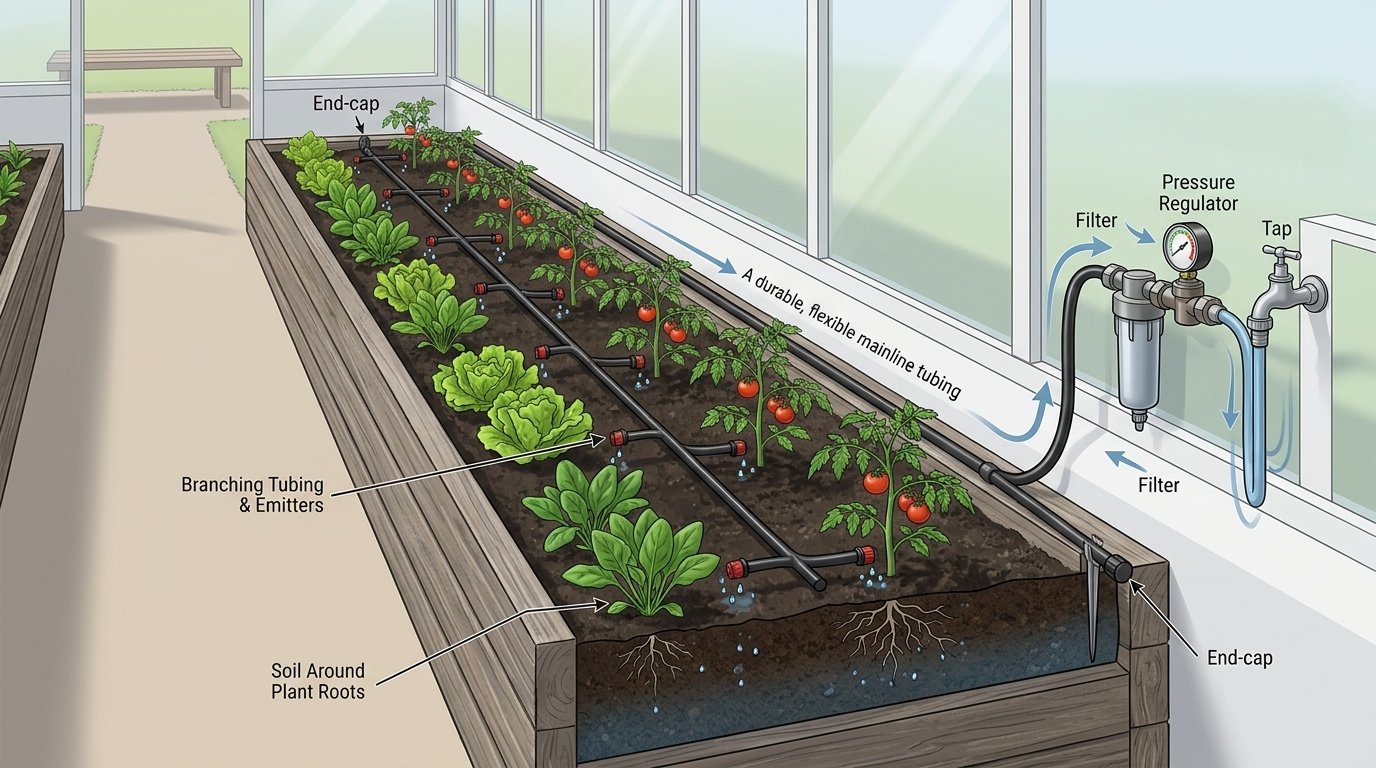
Basic Drip Irrigation Setup Checklist
[ ] Tap connector with a built-in filter and pressure regulator
[ ] Mainline tubing sized to reach every bed or row
[ ] Emitters or drip stakes, one per plant (or spaced evenly along tubing for rows)
[ ] Connectors, tees, and end caps to shape the layout
[ ] An optional timer for automatic operation
[ ] Hole punch tool for attaching emitters to the mainline
Setup sequence:
Connect the filter and pressure regulator directly to your water source. This step matters more than it looks unfiltered water and unregulated pressure are the two most common causes of clogged or unevenly performing emitters.
Run your mainline tubing along the length of your beds or rows.
Punch holes and attach emitters at each plant location, or connect pre-spaced drip tubing if you're watering a continuous row.
Cap off the far end of the line.
Turn on the water and test the system before finalizing your layout walk the full length and check that every emitter is dripping consistently.
Pro Tip: Test your system halfway through installation rather than waiting until everything is connected. It's much easier to fix a weak connection or reposition an emitter while you still have easy access, instead of troubleshooting a fully assembled system.
Automating Your Watering System
Once your drip system is in place, automation is what actually removes watering from your daily to-do list.
A simple timer is the most accessible option. Set it to run at a specific time each day (morning is best, so any incidental moisture on nearby foliage dries before evening) for a set duration, and it handles the rest. This is a solid choice for most home greenhouses.
Soil moisture sensors and tensiometers go a step further by triggering watering based on actual soil conditions rather than a fixed schedule. This is a more advanced setup, more common in commercial operations, but it does address a real limitation of basic timers: a fixed schedule waters the same amount regardless of whether a hot, dry week or a cool, cloudy one means your plants actually need more or less.
For most hobby greenhouses, a timer paired with periodically checking the soil by hand is a perfectly reasonable middle ground you get the consistency of automation without the cost or complexity of sensor-based systems.
Watering Seedlings vs. Mature Plants
Young seedlings and cuttings have shallow, delicate root systems and generally benefit from gentler methods misting, fogging, or capillary matting that don't disturb the soil or risk washing out a not-yet-established root system.
Mature plants are more forgiving and benefit more from consistent, deeper watering at the root zone, which is exactly what drip irrigation and soaker hoses are built for. If you're starting seeds in the same greenhouse where you're growing mature plants, it's worth having two different watering approaches running side by side rather than trying to force one method to serve both stages well.
Water Conservation Tips
Water in the morning. Less water is lost to evaporation in cooler morning temperatures, and any incidental moisture on foliage has all day to dry.
Use mulch around in-ground plants and raised beds to reduce evaporation from the soil surface.
Consider rainwater harvesting. A simple rain barrel connected to your greenhouse gutter system can supply a meaningful amount of water for a drip or soaker-hose setup, especially useful if you're on a metered water supply or facing local water restrictions.
Favor root-level delivery over overhead methods where practical drip irrigation and soaker hoses lose far less water to evaporation than sprinklers or misting systems, since the water never has to travel through open air before reaching the soil.
Troubleshooting Common Problems
Emitters keep clogging. This is almost always a filtration or water-quality issue. Make sure you're using a proper inline filter, and flush your lines periodically by removing the end cap and running water through at full pressure to clear out any sediment that's built up.
Water is distributing unevenly. Check for a kink in the tubing, a partially clogged emitter, or a pressure imbalance across a very long line. If your greenhouse is large, splitting the system into two shorter zones rather than one long run often solves uneven distribution on its own.
The timer isn't running the system on schedule. Double-check the battery (for battery-powered timers) and confirm the valve itself is opening a timer can be working correctly while a stuck valve prevents water from actually flowing.
Plants still seem under-watered despite the system running. Confirm the system is actually reaching the root zone and not just wetting the surface. A quick check with a finger a couple of inches into the soil after a watering cycle will tell you whether water is penetrating deeply enough.
Frequently Asked Questions
What's the best watering system for a greenhouse?
Among greenhouse irrigation systems, drip irrigation is the best all-around choice for most home setups because it delivers water directly to the roots, keeps foliage dry, and uses water efficiently. Soaker hoses are a simpler, lower-cost alternative that works well for raised beds and rows.
What is drip irrigation and how does it work?
Drip irrigation is a watering method that uses tubing fitted with small emitters to release water slowly and directly at the base of each plant. Because the water goes straight to the roots rather than spraying through the air, very little is lost to evaporation and the foliage stays dry.
How do I set up an automatic watering system in my greenhouse?
Connect a filter and pressure regulator to your water source, run mainline tubing to your beds, attach emitters at each plant, cap the line, and add a timer for automatic scheduling. Testing the system partway through installation makes it much easier to catch and fix problems early.
Why do my drip emitters keep clogging?
Clogging is almost always caused by sediment or debris getting into the line, which is why a proper inline filter is essential. If clogging continues, periodically flush your lines by removing the end cap and running water through at full pressure.
Can I water my greenhouse without electricity?
Yes. Drip irrigation and soaker hoses both work fine on standard water pressure alone; you only need electricity if you want an electronic timer. Battery-powered timers are also widely available if you want automation without wiring anything in.
What's the difference between misting and drip irrigation?
Misting releases fine water droplets into the air, mainly to raise humidity and gently moisten foliage it's most useful for seedlings and propagation. Drip irrigation delivers water directly to the roots of established plants and doesn't meaningfully affect air humidity.
Can I use rainwater to water my greenhouse?
Yes, a rain barrel connected to your greenhouse's gutter system can supply water for a drip or soaker-hose setup, and it's a genuinely effective way to reduce your reliance on a metered water supply.
Bringing It All Together
Choosing the right greenhouse irrigation systems comes down to matching the method to your situation: drip irrigation or soaker hoses for most mature plants, misting or capillary matting for seedlings and propagation, and a timer to handle the schedule once everything's connected. None of this requires a large budget or professional installation a basic drip system, a simple timer, and a habit of checking the soil occasionally will solve the vast majority of greenhouse watering problems.
If humidity or disease has been part of what brought you here, our guide to greenhouse ventilation explains the other half of that equation in full. And if you're still working out the rest of your greenhouse routine, our complete guide to greenhouse gardening tips covers temperature, soil, and what to grow alongside everything in this article.