If your greenhouse turns into an oven by early afternoon, or you're finding condensation dripping off the roof every morning, the problem almost always comes down to one thing: not enough of the right kind of airflow. A greenhouse is built to trap heat, which means it will overheat, hold onto humidity, and let disease take hold unless you actively manage the air moving through it.
The good news is that greenhouse ventilation isn't guesswork. There's a real, engineering-based method for figuring out how much ventilation your specific greenhouse needs, and once you understand it, sizing your setup takes a few minutes with a tape measure rather than a lot of trial and error.
Quick answer: Most greenhouses need combined vent openings equal to 15 20% of the floor area, according to University of Massachusetts Amherst Extension guidance based on American Society of Agricultural Engineers recommendations. If you're using a fan instead of (or alongside) vents, size it to move roughly one full volume of air out of the greenhouse per minute. Both passive vents and a fan work better together than either does alone, and your strategy should shift with the seasons cooling in summer, managing humidity in winter.
Why Greenhouses Need Ventilation in the First Place
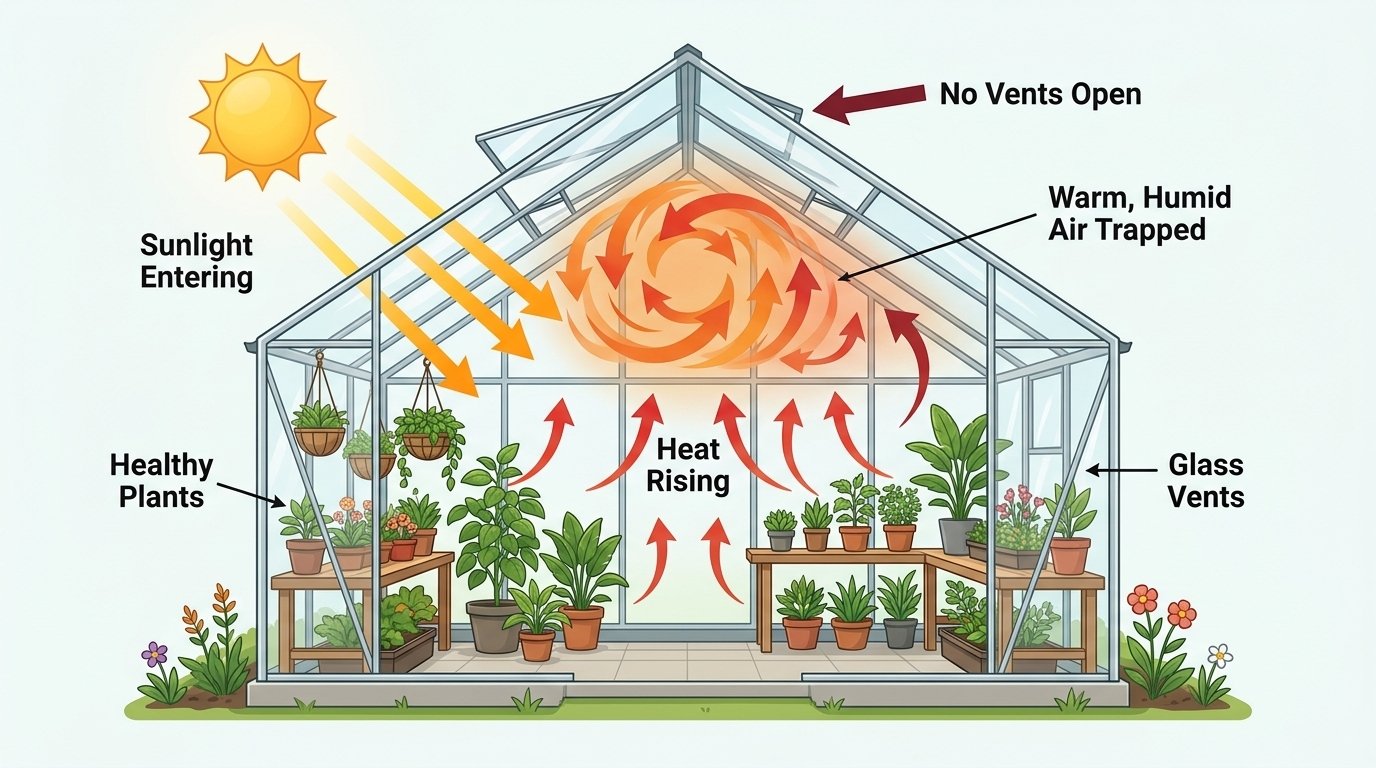
A greenhouse works by letting sunlight in and trapping the heat that builds up as a result. That's the entire point of the structure but it also means the air inside won't regulate itself. Left alone, a sealed greenhouse on a sunny day can climb far past what any plant can tolerate, sometimes within an hour.
Ventilation solves three separate problems at once: it removes excess heat, it replaces stale, humid air with fresh air (which also helps replenish the carbon dioxide plants use for photosynthesis), and it keeps humidity from building up to the point where fungal disease takes hold. Most greenhouse problems that get blamed on "bad luck" scorched leaves, moldy stems, stunted growth trace back to one of these three issues going unmanaged.
Ventilation vs. Circulation: Two Different Jobs
Before going further, it's worth clearing up a mix-up that trips up a lot of greenhouse owners: ventilation and circulation are not the same thing.
Ventilation means exchanging the air inside your greenhouse with fresh air from outside. This is what actually cools the space down, lowers humidity, and brings in new CO2.
Circulation means moving the air that's already inside around evenly, without bringing in any new air. A small oscillating or clip-on fan does this job. Circulation doesn't cool your greenhouse or reduce humidity on its own but it does prevent pockets of hot, stagnant, humid air from collecting in corners or under benches, which is exactly where mold and mildew tend to start.
Most well-run greenhouses use both. Ventilation handles the big-picture climate; circulation handles the smaller pockets that ventilation alone tends to miss. If you've been ventilating consistently and still seeing patchy mold or uneven growth, circulation not ventilation is usually the missing piece.
Passive Ventilation: Letting Physics Do the Work
Passive ventilation relies on two natural forces instead of any powered equipment: wind, and the tendency of hot air to rise.
This second effect is sometimes called the chimney effect or thermal buoyancy. Cool air enters through low side vents or a door, warms up as it moves through the greenhouse, and rises toward the roof. If there's a roof vent open, that warm air escapes there, which pulls in more cool air behind it. The result is a continuous, self-sustaining airflow loop that costs nothing to run.
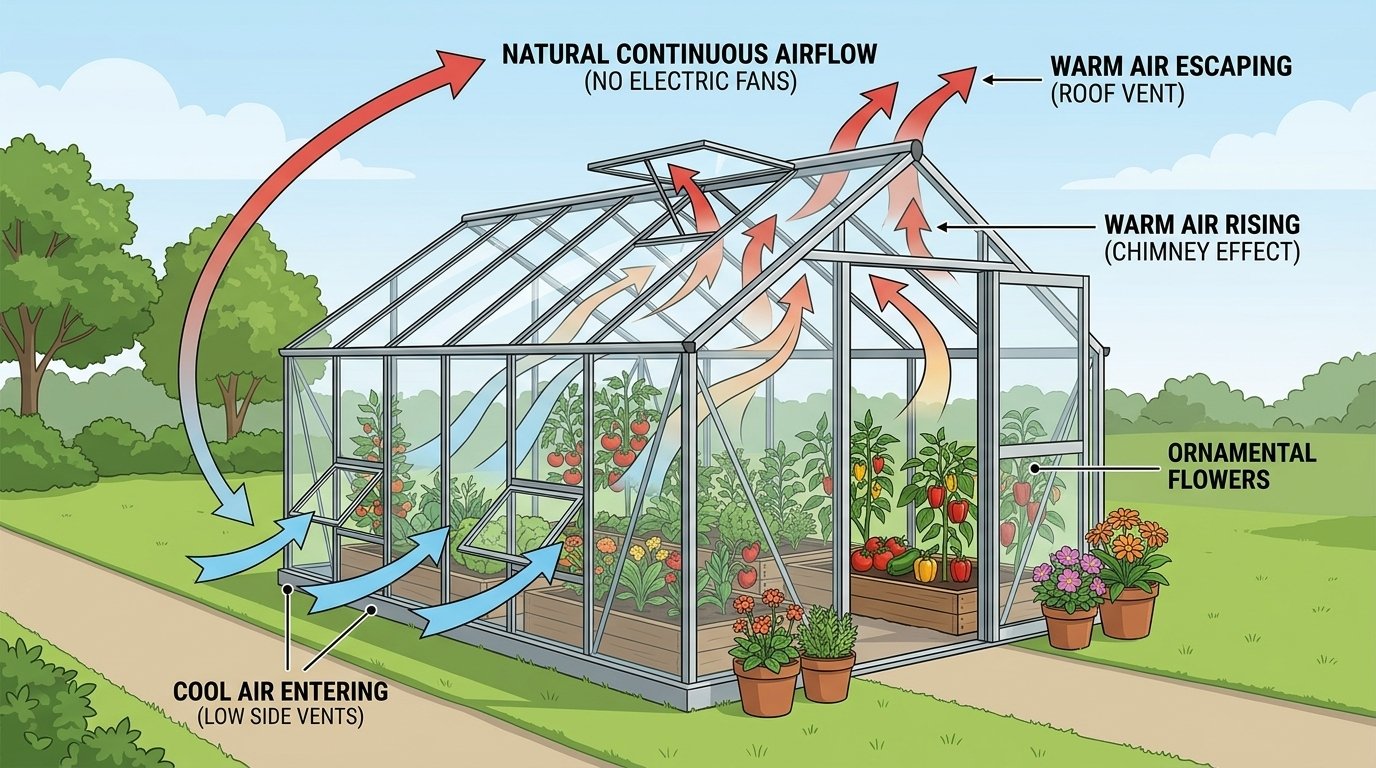
Wind plays a bigger role in this than most people expect. According to UMass Amherst Extension, a wind speed of just 2–3 miles per hour can provide 80% or more of the ventilation a well-designed greenhouse needs. That's a gentle breeze, not a storm which is part of why passive ventilation works surprisingly well on most days, and part of why it can fail badly on the hot, still afternoons when you need it most.
How to set up passive ventilation effectively:
Place intake openings (side vents or a door) low and on one side of the greenhouse.
Place the exhaust opening (a roof vent) as high as possible, ideally on the opposite side or end.
The greater the distance between intake and exhaust, the more of the greenhouse the airflow actually passes through before escaping.
Common Mistake: Relying on a single door or one small vent and assuming it's "enough." On hot, still days, a lone opening depends entirely on unpredictable wind, and airflow can drop to almost nothing exactly when you need it most.
Mechanical Ventilation: Fans, Thermostats, and Reliable Airflow
Passive ventilation has one real weakness: it depends on the weather. Mechanical (fan-powered) ventilation removes that uncertainty by moving air on demand, regardless of wind conditions.
There are two distinct categories of fans worth knowing apart:
Exhaust fans pull hot, stale air out of the greenhouse, which draws fresh air in through vents or louvers to replace it. This is true ventilation an actual exchange with outside air.
Circulation (or horizontal airflow) fans move air around inside the greenhouse without exchanging it with the outside. As covered above, this is circulation, not ventilation, and it's meant to run alongside not instead of proper ventilation.
A thermostatically controlled exhaust fan is the most hands-off option: it switches on automatically once the greenhouse hits a set temperature, so you're not stuck manually opening and closing vents throughout the day.
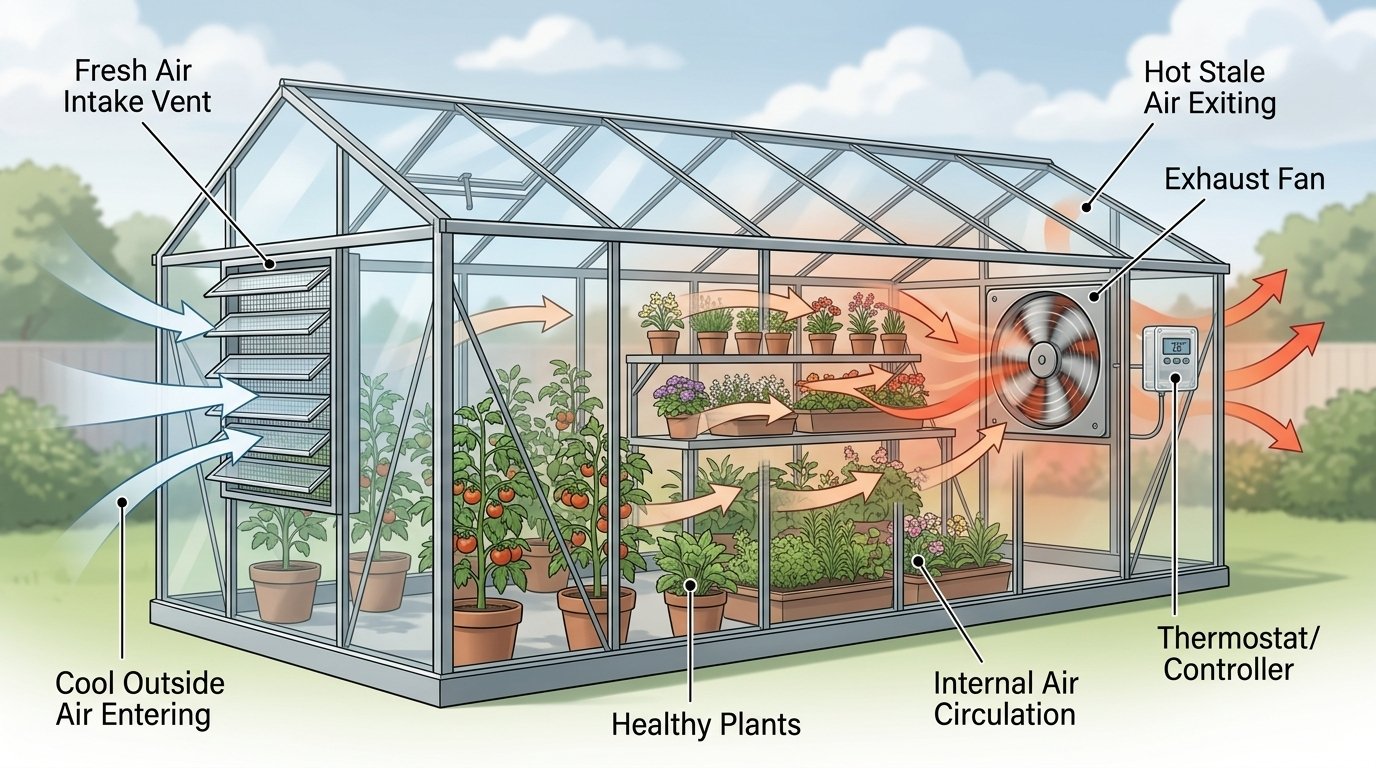
Pro Tip: Always pair a fan with a properly sized intake vent. According to UMass Amherst Extension, the intake opening should be at least 1¼ times the fan's own area an undersized intake creates enough resistance that the fan works harder for less airflow, and can even strain the fan motor over time.
How to Size Your Greenhouse Ventilation Correctly
This is the part most guides skip or get wrong, so it's worth walking through carefully.
For vents (passive ventilation): UMass Amherst Extension, citing American Society of Agricultural Engineers guidance, recommends that combined vent area equal 15–20% of your greenhouse's floor area. This figure comes from commercial greenhouse engineering research, but the underlying physics doesn't change at a smaller, hobby scale — it simply means your total vent openings (roof and side vents combined) should add up to that percentage of your floor space.
For fans (mechanical ventilation): The standard reference point, again from UMass Amherst Extension, is sizing your fan to provide one full volume of air exchange per minute, calculated against a standardized reference height of 8 feet. In practice, that means: multiply your greenhouse's floor area by 8, and that's roughly the fan capacity, in cubic feet per minute (CFM), you're aiming for.
Worked example: Say you have a hobby greenhouse that's 8 feet by 12 feet — 96 square feet of floor space.
Vent area target: 96 × 0.15 to 0.20 = about 14 to 19 square feet of combined vent opening.
Fan size target: 96 × 8 = about 770 CFM.
If you're shopping for a fan, it's also worth checking its Ventilating Efficiency Ratio (VER) — the amount of airflow it produces per watt of electricity used. UMass Amherst Extension considers a VER of 15 or higher (cubic feet per minute per watt) a reasonably efficient choice.
Sizing Reference Table
A note on where these numbers come from: this sizing method is drawn from a 2005 UMass Amherst Extension fact sheet written primarily for commercial greenhouse growers. The underlying engineering principles wind-driven airflow, vent-area ratios, fan exchange rates hold up well at hobby scale, but treat these figures as a solid starting point to size and shop from, not an exact prescription for every possible greenhouse design.
Passive vs. Mechanical Ventilation: Which Do You Need?
Most greenhouse owners end up somewhere in the middle: passive vents as the baseline, with a thermostatically controlled fan as backup for the hottest part of the year. That combination covers both the free, weather-dependent cooling passive systems provide and the reliability a fan adds when the wind isn't cooperating.
Ventilation and Humidity: Why This Is a Disease-Prevention Issue, Not Just a Comfort Issue
It's easy to think of ventilation purely as a temperature problem, but humidity management is arguably just as important and it's the piece most commonly overlooked.
Here's the chain of events: poor airflow lets warm, moist air sit still inside the greenhouse. Overnight, as temperatures drop, that moisture condenses on leaves and other surfaces. Water sitting on leaves for extended periods creates exactly the conditions fungal diseases like powdery mildew and grey mold need to establish themselves. By the time you notice spots or fuzzy growth on your plants, poor ventilation has usually been setting the stage for days or weeks.
Good, consistent airflow interrupts this cycle before it starts, by keeping humid air moving and preventing it from settling and condensing overnight.
Did You Know: Ventilation and circulation solve two different problems, but they work together against disease. Ventilation removes humid air entirely; circulation keeps any remaining humidity from pooling in one spot long enough to cause trouble.
If you're already seeing mold, mildew, or fungal spotting, improving ventilation going forward will help prevent it from returning but treating an active infection usually requires additional steps beyond airflow alone.
Adjusting Ventilation by Season
Your ventilation strategy shouldn't stay the same all year, because the problem you're solving changes with the seasons.
Spring and summer: The priority is heat management. Vents and doors typically need to stay open for most of the daylight hours, and a thermostatically controlled fan earns its keep on the hottest days.
Warning: Sustained temperatures above roughly 81°F can cause visible stress in many common greenhouse crops leaf scorch, wilting, and reduced fruit set. This threshold shows up consistently across horticultural sources, so it's a reasonable trigger point to start ventilating aggressively if you notice your greenhouse regularly running hotter than this.
Fall and winter: The priority shifts to humidity and condensation management rather than cooling. Brief, controlled venting even for a few minutes on a cold day can release built-up moisture without losing all your accumulated heat. This is also when a winter-specific fan-and-tube ventilation system (which mixes incoming cold air with the greenhouse's own warm air before it reaches plant level) becomes worth considering for larger structures.
Choosing Your Ventilation Setup by Budget
You don't need every option at once. Here's a realistic way to think about it depending on your budget and how hands-on you want to be:
No-cost / manual: Vents and a door you open and close by hand as temperatures change. Works fine for small greenhouses if you're home to manage it, but leaves you exposed on the days you can't check in.
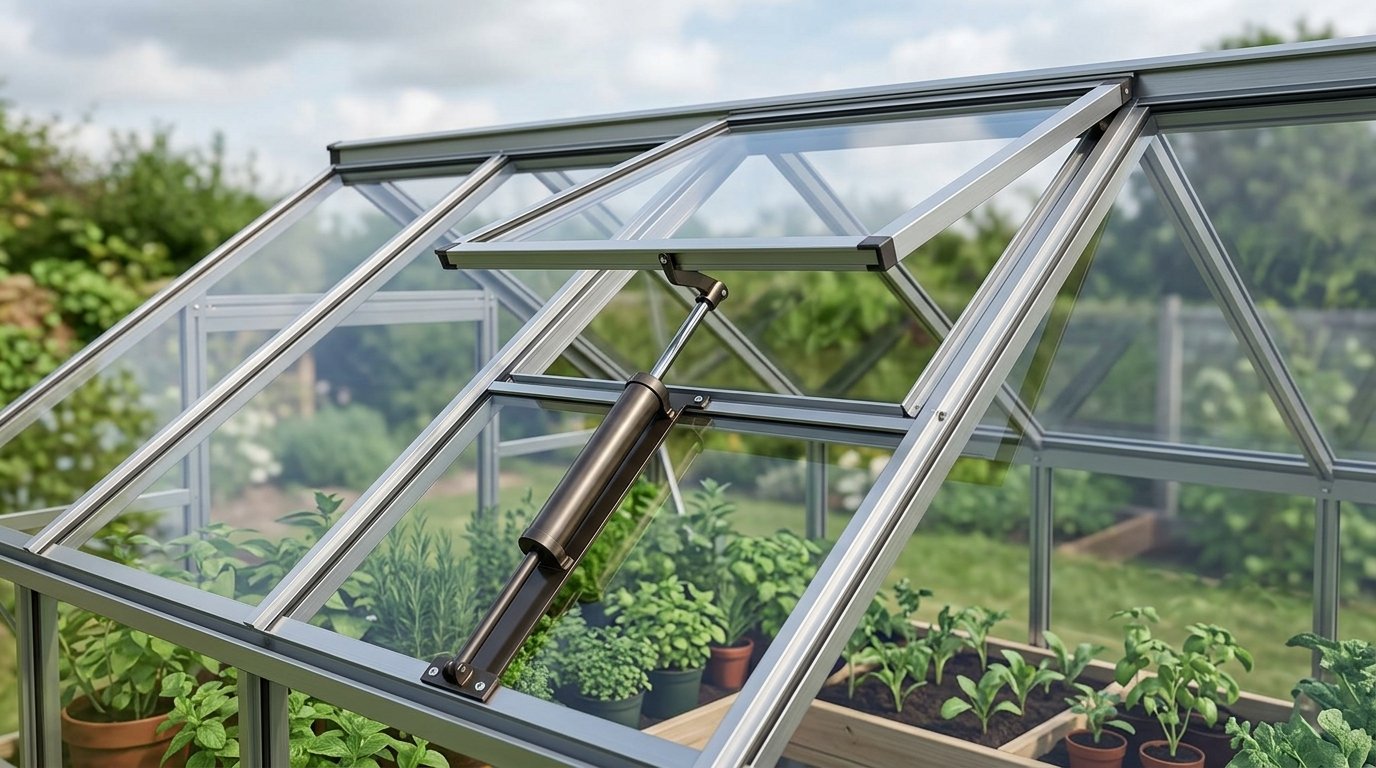
Low-cost/automatic: A wax-cylinder automatic vent opener uses no electricity at all — the wax inside expands as temperatures rise, physically pushing the vent open, and contracts again as it cools. This is a genuinely useful middle ground for anyone who wants hands-off operation without wiring in a powered system.
Higher investment / powered: A thermostatically controlled exhaust fan, ideally paired with a properly sized intake vent (see the sizing section above). This is the most reliable option and the best fit for larger greenhouses, hot climates, or anyone who can't manually adjust vents throughout the day.
Is Your Greenhouse Ventilation Adequate? A Quick Checklist
[ ] Combined vent area equals at least 15–20% of your floor area
[ ] Intake and exhaust openings are positioned on opposite sides or ends of the greenhouse
[ ] If using a fan, intake vent area is at least 1¼ times the fan's own area
[ ] You have a thermometer (ideally a min/max or hygrometer-equipped model) to monitor conditions
[ ] Your ventilation routine changes between summer (cooling-focused) and winter (humidity-focused)
[ ] You're checking for condensation or humidity buildup, not just temperature
Frequently Asked Questions
Why does my greenhouse get so hot even with the door open?
A single door depends entirely on wind to move air, and on hot, still days, that airflow can drop to almost nothing. One opening also doesn't create the intake-to-exhaust airflow path that a roof vent paired with a low side vent or door provides.
What size fan do I need for my greenhouse?
A commonly used starting point is to multiply your greenhouse's floor area by 8 to get an approximate target in cubic feet per minute (CFM) this is based on UMass Amherst Extension's one-air-exchange-per-minute standard. For a 96 square foot greenhouse, that works out to roughly 770 CFM.
What's the difference between a circulation fan and an exhaust fan?
An exhaust fan pulls air out of the greenhouse and draws fresh outside air in that's ventilation. A circulation fan just moves the air already inside around more evenly that's circulation. Most greenhouses benefit from having both.
Do I need both vents and a fan, or is one enough?
Vents alone work for smaller greenhouses in milder climates, especially with an automatic opener. Larger greenhouses, hot climates, or setups where you can't check in daily generally benefit from adding a thermostatically controlled fan as backup.
How do I stop condensation and mold in my greenhouse?
Improve airflow so humid air doesn't sit and condense overnight, and consider adding a circulation fan to prevent stagnant pockets from forming in corners or under benches. If mold or mildew is already present, ventilation alone will help prevent its return, but you may need additional treatment to address the active problem.
Do I need to ventilate my greenhouse in winter?
Yes, though the goal shifts. Instead of cooling, winter ventilation is mainly about releasing built-up humidity and condensation, which can happen with just brief periods of venting rather than keeping vents open all day.
Can I ventilate a greenhouse without electricity?
Yes. A wax-cylinder automatic vent opener requires no power source at all and will open and close vents based on temperature alone, making it a solid option if you don't want to run electrical wiring to your greenhouse.
Putting It All Together
Getting greenhouse ventilation right comes down to a few connected ideas: understanding that ventilation and circulation solve different problems, sizing your vents and fan against your actual floor area rather than guessing, positioning intake and exhaust openings to create a real airflow path, and adjusting your approach as the seasons change from cooling in summer to humidity management in winter.None of this requires expensive equipment to get started. A tape measure, an honest look at your current vent area, and a willingness to add a fan if your climate or greenhouse size calls for it will solve the vast majority of overheating and humidity problems.
If you haven't yet worked out your full greenhouse routine, our guide to greenhouse gardening tips covers the complete picture, including watering, soil, and what to grow first. And if humidity or mold has already become a recurring problem, our guide to greenhouse pest and disease control picks up where prevention leaves off.